
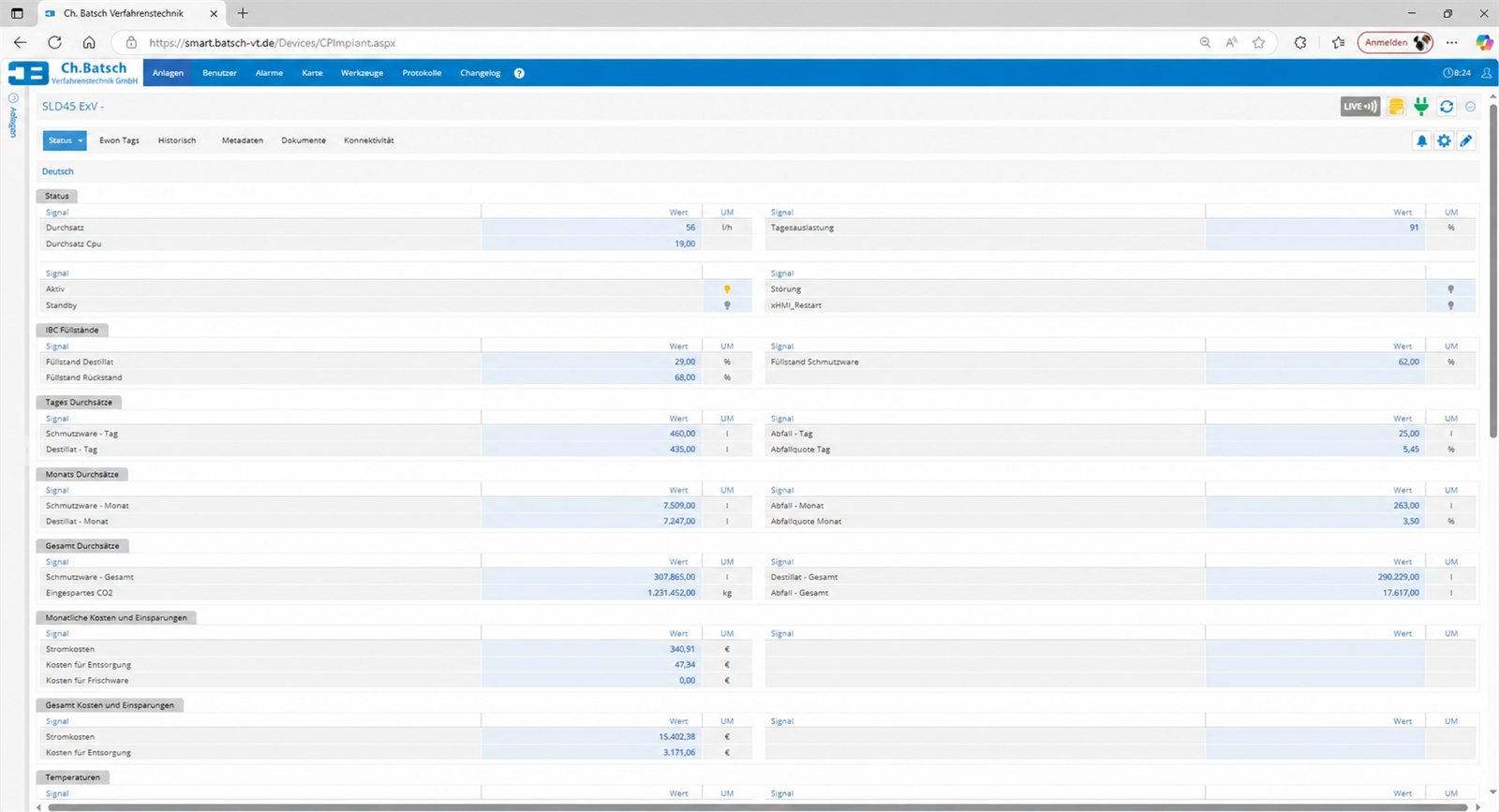
When is industrial solvent recycling economical?
A project can be economical when the value of recovered solvent and avoided waste and logistics costs exceeds the cost of recovery and integration. The decisive variables are site-specific.
Which values belong in a reliable calculation?
- Contaminated solvent quantity and variation
- Validated recovery and reuse rate
- Purchase price of virgin solvent
- Waste treatment and transport costs
- Energy, utilities and residue handling
- System, integration, service and operating costs
- Defined baseline and evaluation period
How is the CO₂ effect calculated?
A credible comparison defines system boundaries. It considers avoided production and delivery of virgin solvent, avoided external transport and treatment, energy used for on-site distillation and the remaining residue route.
Batsch does not currently publish one blanket CO₂-saving percentage. A value is released only when input data, period, baseline and calculation method are clearly established.
How does solvent recycling affect the VOC balance?
Solvent recycling does not automatically remove the legal VOC classification of a solvent. It may reduce purchasing, waste movements and associated handling, while emissions at the actual use point remain subject to the applicable process and legal framework.
Which data does Batsch need for project assessment?
- Material and safety data
- Daily and monthly volume
- Virgin-solvent purchasing data
- Waste and logistics data
- Intended reuse point and quality criteria
- Production times, utilities and site conditions
Direct answers
Frequently asked questions
How much can solvent recycling save?
No reliable percentage can be stated without actual material, quantity, quality, cost and baseline data.
Does recovery reduce waste?
It can substantially reduce the liquid solvent stream sent off site by returning distillate to use; the remaining concentrated residue still requires proper management.
Does recovered solvent improve the VOC balance?
It can change purchasing and waste flows, but VOC obligations at the point of use require site-specific assessment.
Technical basis
Practical expertise and sources
The technical information on this page is based on Batsch system and project data as well as actual trial distillations. Values are always stated in their application context; confidential customer and project data remain protected.
- Batsch operating-model documentation, January 2026 – own data
- EU Waste Framework Directive
- German solvent ordinance