
Why is distillation performed under vacuum?
A liquid's boiling point depends on pressure. Reducing system pressure allows evaporation at a lower temperature. This creates additional options for controlled separation of temperature-sensitive or complex solvent mixtures.
Vacuum alone does not determine quality. Composition, heating, condensation, residue behaviour and dynamic process control must be considered together.
Which steps form part of solvent distillation?
- Controlled feed of contaminated solvent
- Vacuum generation and control
- Heating and evaporation of recoverable components
- Condensation and collection of distillate
- Monitoring of levels, flow, temperature and safety states
- Discharge and assessment of concentrated residue
- Return of validated distillate to production
What is dynamic process control?
Industrial solvent streams vary. The SLD continuously records relevant operating states and adjusts the process within the project-specific control strategy. Batsch monitors system status and process data remotely.
The number of sensors alone is not a quality criterion. What matters is which variables are required for the actual material, how they are evaluated and which process response follows.
How is a distillation system sized?
Sizing starts with the solvent stream rather than a generic litres-per-hour figure. Batsch assesses daily and monthly quantities, composition, contamination, required distillate quality, production times, tank management, utilities and site conditions.
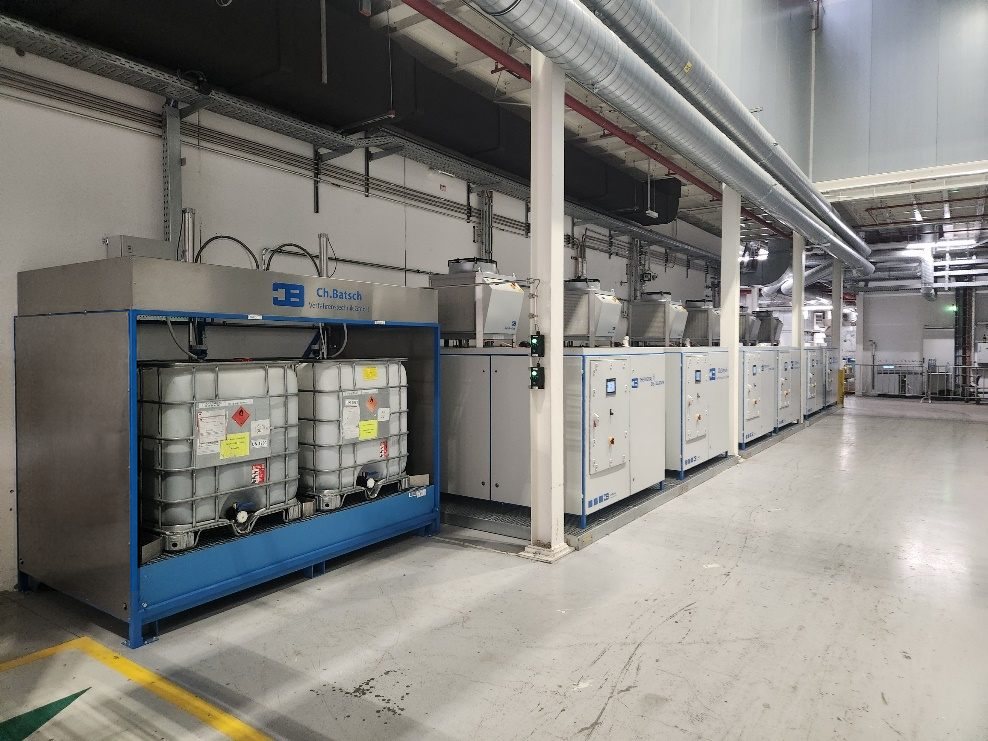
The SLD 45 ExV is rated at approximately 45 l/h and the SLD 100 ExV at approximately 100 l/h. Current modular Batsch customer installations range from 800 to 10,000 litres per day. These values describe specified models and project combinations, not guaranteed output for every material.
What role do ATEX and explosion protection play?
Solvent distillation may involve flammable liquids and explosive atmospheres. Hazardous-area classification, equipment category, ventilation, ignition-source control and the site's protection concept must be defined for each project.
Direct answers
Frequently asked questions
Does vacuum distillation always increase recovery?
Not automatically. It changes the boiling conditions; recovery still depends on composition, contamination, residue and the defined process limits.
Which solvents can be distilled?
This can only be assessed reliably from the actual material, safety data and required reuse quality.
How is distillate quality monitored?
Quality is validated initially and monitored in operation through regular sampling and recorded process data.
Technical basis
Practical expertise and sources
The technical information on this page is based on Batsch system and project data as well as actual trial distillations. Values are always stated in their application context; confidential customer and project data remain protected.
- Batsch SLD 45 ExV and SLD 100 ExV technical documentation – own model data
- EU ATEX Equipment Directive 2014/34/EU